
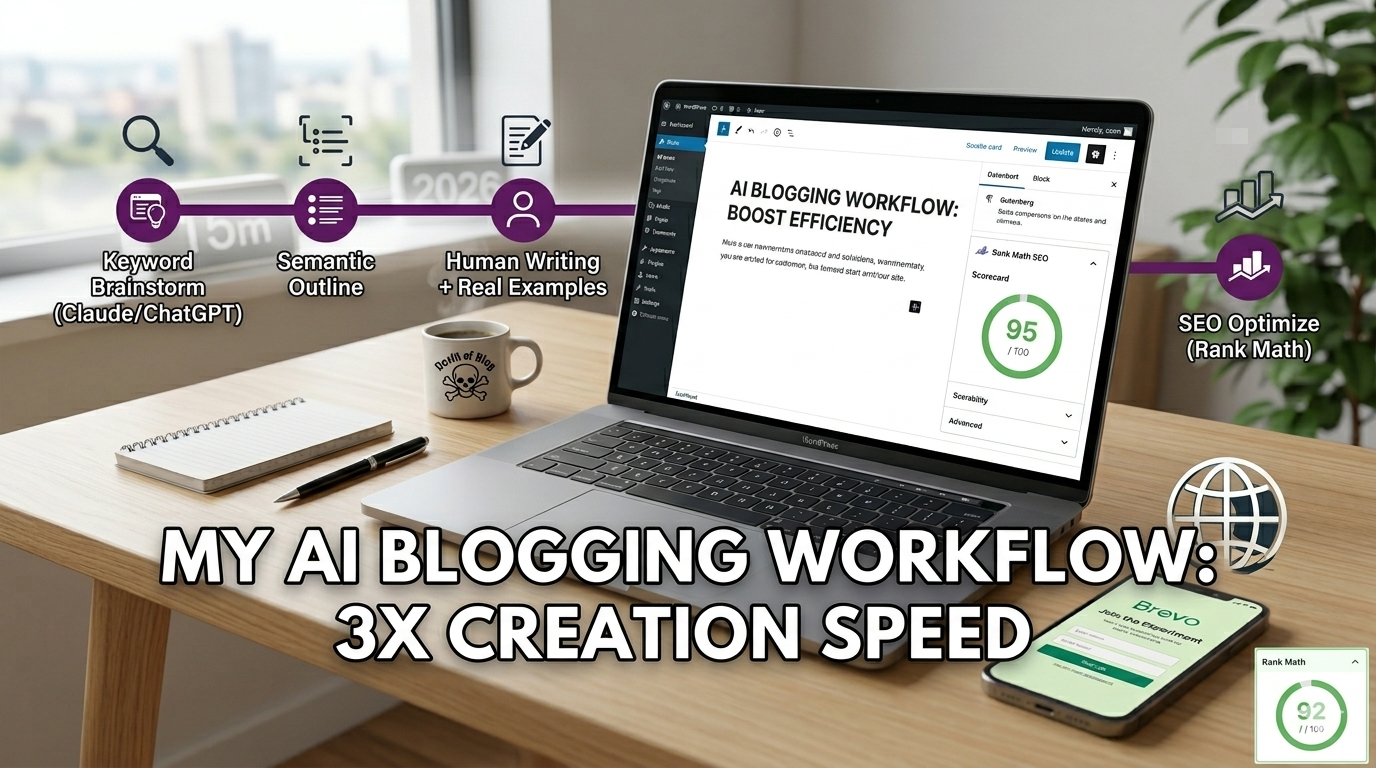

An efficient AI blogging workflow is the ultimate secret weapon for modern content creators who want to survive in a crowded digital landscape.
Starting a brand new online venture as a solo pioneer can feel incredibly overwhelming. Between brainstorming viral topics, digging through deep search intent, and keeping up with a strict publishing schedule, your creative energy can burn out fast. In 2026, successful digital entrepreneurs don’t struggle through manual labor—they establish a high-speed system by treating Artificial Intelligence as an elite co-pilot rather than a lazy copy-paste tool.
However, there is a massive line between blind automation and elite execution. If your goal is to build a sustainable digital asset that resonates with human readers and dominates search algorithm landscapes, you need a precise blueprint. In this practical guide, I will deconstruct my exact AI blogging workflow that has successfully tripled my production output without risking content depth or brand authenticity.
The Fatal Pitfall: Why Blind Automation Triggers Digital Death
Before pulling back the curtain on the actual framework, we must address a critical mistake destroying new sites. The absolute worst mistake a creator can make is generating full-length articles with a single, lazy prompt like “write a 1,500-word article about niche marketing tips.”
Purely automated content that skips human editing always suffers from three fatal issues:
- Monotonous and Repetitive Tone: The phrasing feels clinical, robotic, and lacks an authentic personal brand voice.
- Zero Real-World Context: AI engines cannot draw from actual human experience, personal experiments, or unique laboratory data.
- Search Engine Devaluation: Modern search quality algorithms heavily penalize sites that lack unique, firsthand expertise and information gain.
💡 The Strategic Golden Rule: Always treat intelligence engines as your internal brainstorm partner, research research assistant, and structural architect—never ever use them as a blind ghostwriter.
Deconstructing the 3x Efficiency AI Blogging Workflow
By shifting AI completely away from direct copywriting and focusing its computational power entirely on the prep work phase, you can destroy writer’s block forever. Here is how you can implement this system into your business model immediately:
Step 1: Hyper-Targeted Keyword Discovery & Intent Mapping
Instead of guessing blindly what global users are actively typing into search bars, use AI to map out semantic keyword clusters. You can feed baseline topic data into large language models to uncover highly profitable long-tail keywords that traditional SEO software completely overlooks.
To implement this in your own AI blogging workflow, try feeding your engine this exact custom prompt:
"Act as an elite SEO growth strategist. My target niche is digital nomads and side hustlers. Generate a comprehensive list of 15 hyper-specific long-tail keywords regarding 'building a digital side hustle from scratch' that focus on informational search intent and address painful beginner problems."
Step 2: Designing a Rigid Semantic Article Outline
An article with weak structural flow guarantees a high bounce rate. Once you lock in your ideal target keyword phrase, use your AI assistant to architect a bulletproof content flow. Force the model to study live ranking structures and recommend critical subheadings (H2 and H3 tags) required to satisfy user intent completely.
Step 3: Injecting the Human Soul, Case Studies, and Assets
This is where your unique advantage comes alive. Take the structured skeleton generated by your system and build the muscle yourself. Write the actual core arguments, inject your raw operational data, tell your unique personal story, and seamlessly connect to your previous case studies—such as my comprehensive step-by-step WordPress setup guide—to maximize internal authority.
Essential Software to Power Your Automated Pipeline
To run this operational structure at maximum capacity without friction, you need to rely on a solid, reliable tech stack:
- Claude & ChatGPT: Currently the top companion engines for creating advanced structures, semantic brainstorming, and polishing rough editorial ideas.
- Rank Math SEO: The definitive gold standard for real-time WordPress post optimization. It keeps your keyword placement on point across headings, tags, and metadata.
Join the Survival Experiment
Deploying a structured framework isn’t about taking shortcuts; it is about freeing up valuable mental bandwidth so you can scale your brand, focus on monetization, and build deep community loyalty.
I want to hear directly from you: What specific software tools are currently driving your content production pipeline? Let’s drop a comment and discuss below!